Feedback Guided Changes
Due to limited contact time with PgCert tutors, resulting from the absence of allocated study time for the course, I have relied heavily on feedback from students and colleagues throughout the ARP process. While this is already a core aspect of my practice, it proved particularly valuable in informing future adaptations to the workshop delivered as part of the ARP.
Feedback from colleagues corroborated several of my own observations about the session and directly informed the revised workshop timeline presented in the PDF above, as well as the changes outlined in the “Other Proposed Changes for Future Workshops” section of the same document. In addition, I received the following feedback:
Colleague 1: “a large screen to show the presentation you made and have it accessible for everyone to see/read the text”
My reflections: I will make a request that we purchase a large monitor and camera so presentations and hand embroidery sessions can be life projected.
Colleague 2: “very well put together workshop. I really enjoyed it!”
My reflections: It is easy to forget that the enjoyment of the teaching staff is also important!
Student 1: “talking about the background of each stitch as we learn it would be interesting”
My reflections: I hope to introduce this to my next workshop “Stitching Disobedience” and the “Art for resistance anthology” (See below)
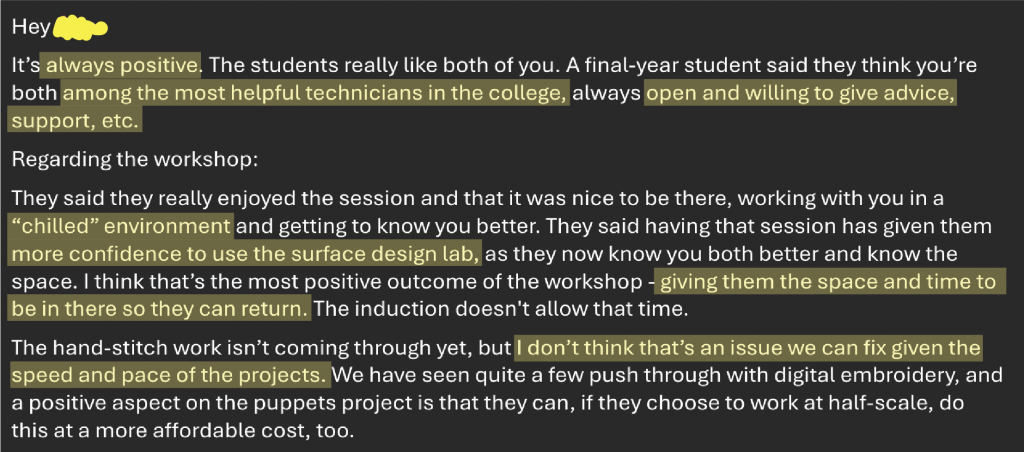
I have included an email from the course leader below in regards to student feedback more broadly, and feedback on the “Stitching the Self” session.
What Would Freire Do?
Engaging with academic literature has been invaluable in shaping my research process. At this stage of the project, there are several areas I would like to develop further in future iterations of the Stitching the Self workshop and in subsequent teaching sessions. Richard Sennett describes the workshop as the “craftsman’s home” (2008:53), a sentiment I share and one I hope students experience within my own teaching. However, student feedback has highlighted that workshops can also feel intimidating spaces, where a lack of confidence can inhibit engagement with learning.
The power dynamics embedded in the figure of the workshop “master” and their perceived “right to command” obedience (Sennett, 2008:54) are dynamics I have sought to unsettle through this ARP. In response, I have developed activities—outlined below—that aim to more explicitly affirm Freire’s assertion that learners “know things too” (Freire, 1968:63), and to reposition students as active participants in knowledge production.
Chain-stitch activity
Two technicians each teach a stitch to two students, who are then tasked with passing that knowledge on to their neighbours. This exercise encourages students to recognise their own capacity to teach, while granting them autonomy in how knowledge is shared.
Make-your-own-stitch activity
After learning a small set of foundational stitches, students are asked to design their own. This activity is intended to dissolve the hierarchy of the skilled “master” (Sennett, 2008:54), demonstrating that stitches—often perceived as fixed outcomes of long-established craft traditions—are in fact sequences of movements that can be adapted, reimagined, and played with by anyone.
While these adaptations represent meaningful steps, they mark only the beginning of what I anticipate will be a career-long process of reflection, critical engagement, and action to improve my teaching practice. This project has been both challenging and illuminating, and I am deeply grateful for the opportunity to undertake the PgCert.
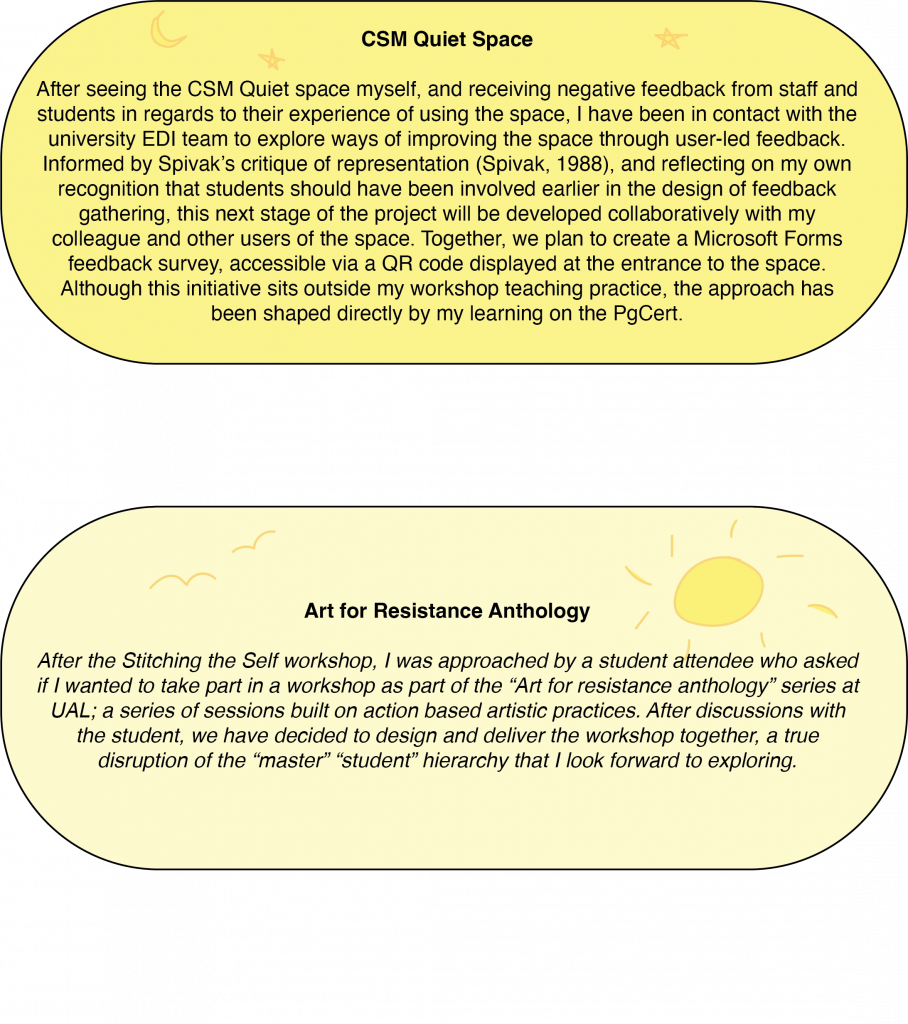
I have added a couple of unexpected outcomes of the ARP process below.
References
Freire. P (2005) Pedagogy of the Oppressed (50th anniversary ed.) Translated by Myra Bergman Ramos. The Continuum International Publishing Group, New York. (Original work published 1968)
Sennett, R (2008) The Craftsman. Yale University Press