Embodied research methods: A hybrid approach
As the feedback form combined both quantitative and qualitative research methods, the questionnaire data was analysed using a hybrid approach. Quantitative responses were examined using the data visualisation tools embedded in Microsoft Forms (See PDF), while qualitative responses were analysed through an embodied, reflexive thematic analysis framework (Braun and Clarke, 2022).
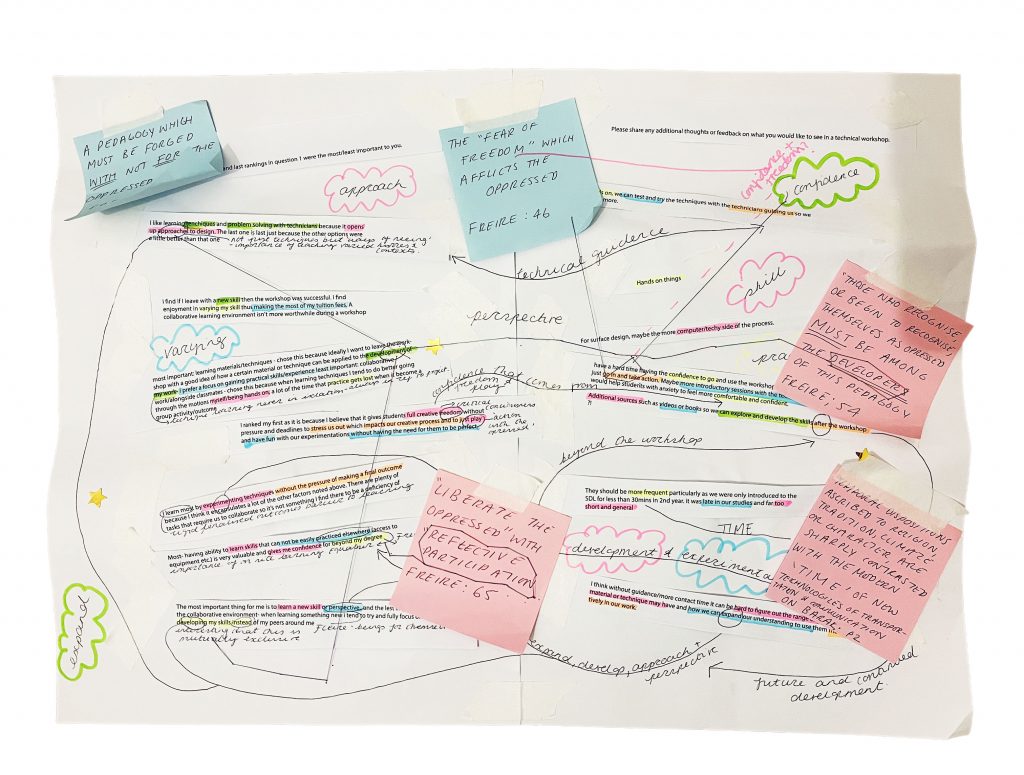
To begin the qualitative analysis, I printed the descriptive student responses to questions two and six, physically cutting them out and arranging them on a larger surface (Figure 1). This process enabled me to identify patterns, recurring language, and shared sentiments across the data, while also drawing connections between these responses and relevant academic literature. Post-it notes were used to introduce ideas from theoretical texts, and relational links were physically stitched using needle and thread.
By positioning my body as an “active subject” in the production of knowledge (Torkild and Knights, 2019:10), I extended cognition beyond purely textual analysis, engaging instead with the material qualities of stitch-making. The inherent properties of this craft – slowness, attentiveness, rhythmic movement, intentionality, and tacit learning -became analytical tools through which relationships within the data were explored (Kara, 2015). While I do not frame the resulting stitched map as an artwork, the process aligns with creative practice as an “intervention” for generating new forms of understanding (Jokela and Huhmarniemi, 2018:9). Combining fast, intuitive acts such as highlighting and note-taking with slower, deliberate stitching enabled multiple temporalities of reading and interpretation, resulting in a richer and more nuanced set of thematic patterns.
Thanem and Knights use the Suffragettes as a key example of embodied action, highlighting how their bodies were mobilised through practices such as hunger strikes and public protest (Thanem and Knights, 2019:7). Importantly, the Suffragettes also engaged in embodied making practices, including embroidery, producing protest banners and stitching their signatures onto handkerchiefs while imprisoned (Backhouse, 2018). These acts intersect embodied knowledge production with embodied action and interaction (Thanem and Knights, 2019:7). Engaging with this framework has opened up new perspectives on data analysis, demonstrating the inherently intersectional nature of embodied approaches—an approach that feels holds a unique relevancy within art and design research contexts given the fields relationship with our bodies as conduits for making.
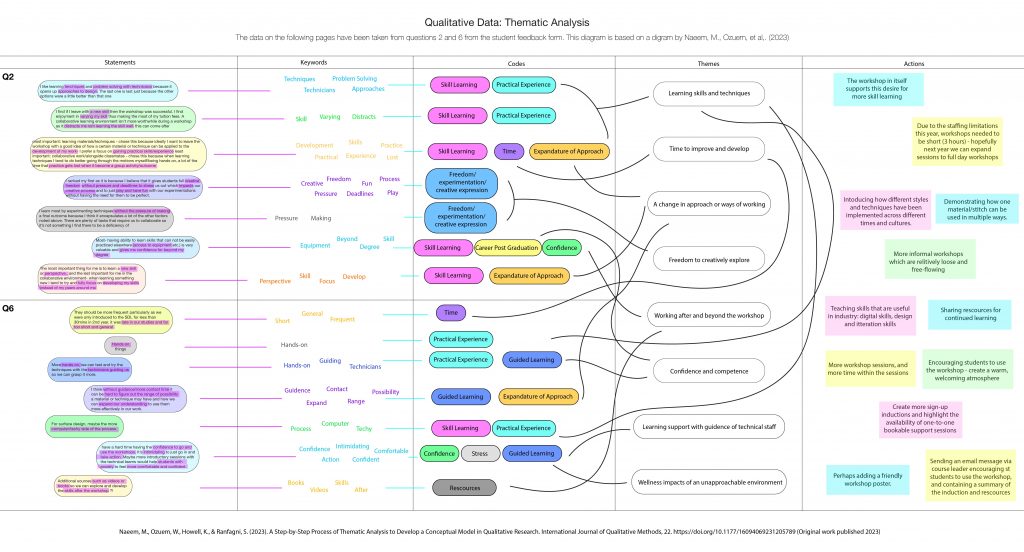
I further expanded my mind map using thematic analysis (Braun and Clarke, 2006) – this was selected over discourse or narrative analysis, as the questionnaire focused on gathering participants’ experiences, views, and perceptions. My primary concern was identifying patterns across the data in order to respond meaningfully to student feedback through adaptations aligned with shared needs. Using a reflexive thematic analysis approach (Figure 2) enabled deeper engagement with the data and the identification of themes that were less visible during on-screen analysis alone (Braun and Clarke, 2022), capitalising on the effect of “thinking through making” (Sennett, 2009:1). The resulting findings are presented below, and have been directly referenced in the planning of the “Stitching the Self” workshop and it’s accompanying presentation slides.
References
Backhouse, S (2018) “Hunger Strikes and Handkerchiefs | RCP Museum.” rcp.ac.uk [online] accessed via: history.rcp.ac.uk/blog/hunger-strikes-and-handkerchiefs.
Braun, V. & Clarke, V. (2022) “Doing Reflexive TA | Thematic Analysis.” Www.thematicanalysis.net, www.thematicanalysis.net/doing-reflexive-ta/.
Braun, V. & Clarke, V. (2006) Using thematic analysis in psychology, Qualitative Research in Psychology, 3:2, 77-101, DOI: 10.1191/1478088706qp063oa
Jokela, T.S., and Huhmarniemi, M.E. (2018) “Art-Based Action Research in the Development Work of Arts and Art Education.” University of Lapland EBooks, pp. 9–23.
Kara H., (2015). Creative research methods in the social sciences. Bristol: Policy Press.
Naeem, M., Ozuem, W., Howell, K., & Ranfagni, S. (2023). A Step-by-Step Process of Thematic Analysis to Develop a Conceptual Model in Qualitative Research. International Journal of Qualitative Methods, 22. https://doi.org/10.1177/16094069231205789 (Original work published 2023)
Sennett, R. The Craftsman. London, Penguin Books, 2009.
Torkild, T, and Knights, D (2019) Embodied Research Methods. Sage. DOI: https://doi.org/10.4135/9781529716672.