The initial rationale for this ARP emerged from a troubling dual realisation: that UAL has a documented attainment BAME attainment gap of 17% in 2022 (UAL, 2023; Mba, David, et al, 2023), and that the modes of technical teaching within my own practice may contribute to the wider privileging of Western histories and forms of knowledge. In practical terms, this manifests in the following:
- Exclusively using Anglo-American or European terms to describe methods and techniques, even if these techniques had other names and originated outside of these geo-cultural spheres
- Perpetuating a ‘West is Best’ attitude by only teaching Anglo-American/European renditions of techniques, not even mentioning that others exist, thereby “conserving the subject of the West, or the West as Subject” (Spivak, 1988:1) as well as censoring histories via omission (Macedo, 2005:16)
- Attempting to create ‘neutral’ skill learning, teaching embroidery by making rows of stitches dismembered from their context and meanings (Shaull, 2005:34)
Linda Nochlin’s seminal essay, which asks “Why have there been no great women artists?”, provides a useful parallel when considering the question of why BAME students, on average, achieve lower outcomes than their White peers. As in Nochlin’s analysis, the answer does not lie in any inherent deficiency, but in the structural conditions that shape access, recognition, and value. The suggestion that women artists—or, by extension, BAME students—are incapable is clearly untenable; rather, it is the societal and institutional frameworks in which they operate that systematically limit opportunity. This extends to higher education institutions such as UAL. The critical question, then, is how UAL may perpetuate the conditions that allow the attainment gap to persist, and how technical teaching practices might be implicated within this context.
The first phase of my ARP development cycle involved identifying the problem, as outlined above, and forming the hypothesis that addressing these issues would represent a step towards more inclusive approaches to embroidery teaching within a workshop context. While the original plan for the second phase was to implement these changes directly in an upcoming embroidery workshop, advice from Carys Kennedy highlighted that consulting students prior to delivery would better align with the project timeline. An altered Action Research Cycle can be seen below.
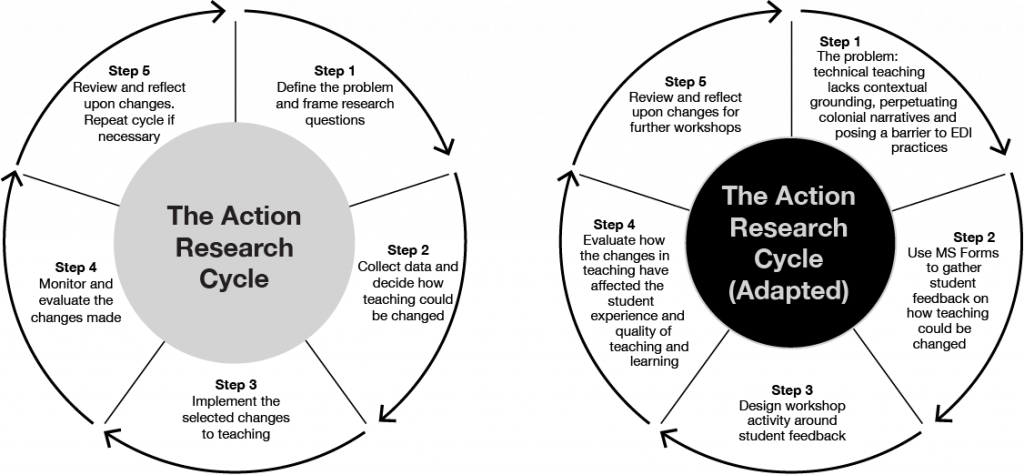
More importantly, this approach serves to disrupt hierarchical power structures embedded in research practices and enables marginalised communities to articulate their own needs and experiences (Timmis, S. et al., 2024:1804). The significance of “taking action with the oppressed” (Friere, 1968:66) and genuinely trusting their capacity to inform change is central to Freire’s Pedagogy of the Oppressed, a text that has had a profound influence on my thinking. By reframing students not as research ‘subjects’ but as co-contributors to the ARP (Timmis, S. et al., 2024:1794), I seek to resist an essentialist approach that risks collapsing diverse voices into a predetermined narrative (Spivak, 1988:26).
References
Freire. P (2005) Pedagogy of the Oppressed (50th anniversary ed.) Translated by Myra Bergman Ramos. The Continuum International Publishing Group, New York. (Original work published 1968)
Mba, David, et al (2023) UAL Ethnic Representation Index [online] Available via: https://www.arts.ac.uk/__data/assets/pdf_file/0010/410212/ERI-Ethnic-Representation-Index-2023-PDF-1.2MB.pdf
Macedo, D (2000) in Freire. P (2005) Pedagogy of the Oppressed (50th anniversary ed.) Translated by Myra Bergman Ramos. The Continuum International Publishing Group, New York. (Original work published 1968)
Nochlin, L. (1971) ‘Why Have There Been No Great Women Artists?’, ARTnews, 69(9), pp. 22–39, 67–71.
Shaull, R (2005) in Freire. P (2005) Pedagogy of the Oppressed (50th anniversary ed.) Translated by Myra Bergman Ramos. The Continuum International Publishing Group, New York. (Original work published 1968)
Spivak, G.C. (1988) ‘Can the Subaltern Speak?’, in Nelson, C. and Grossberg, L. (eds.) Marxism and the Interpretation of Culture. Basingstoke: Macmillan Education, pp. 271–313.
Timmis, S. et al. (2024) ‘Students as co-researchers: participatory methods for decolonising research in teaching and learning in higher education’, Teaching in Higher Education, 29(7), pp. 1793–1812. doi: 10.1080/13562517.2024.2359738.
UAL (2023) “Ethnic Representation Index.” [online] available via: www.arts.ac.uk/about-ual/equality-and-diversity/ethnic-representation-index.